Impact Windows for Florida Condos & High-Rise Buildings 2026
Who pays, HOA authority under FS 718.113, Surfside law requirements, DP ratings by floor, and your rights as a unit owner
⚡ Key Facts for Florida Condo Owners
- ✅ FS 718.113 allows HOA boards to install impact windows without a unit vote
- ✅ Costs can be assessed to unit owners — even without individual consent
- ✅ Upper-floor windows need higher DP ratings than ground-floor
- ✅ Above 30 ft: small missile testing allowed; below 30 ft: large missile required
- ✅ Post-Surfside SIRS study may include hurricane protection as a capital item
- ✅ Condo master policy covers building envelope — your HO-6 covers interior
Impact windows in a condo or high-rise building are significantly more complex than in a single-family home. There are three parties involved — the building association, the unit owner, and Florida law — and understanding who controls what, who pays, and what specifications are required at different floors determines how a project actually gets done.
The 2021 Surfside collapse and the 2022 structural integrity legislation changed how Florida condo associations must plan and fund building envelope work. Combined with Florida Statute 718.113, boards now have both the authority and, in many cases, the obligation to upgrade hurricane protection.
This guide covers the legal framework, who pays and how, the specific DP rating requirements that change with floor height, and the step-by-step process an association uses to run a building-wide impact window project.
A High-Rise Impact Window on a Real Job
A black horizontal rolling impact window in a high-rise condo unit in South Florida.
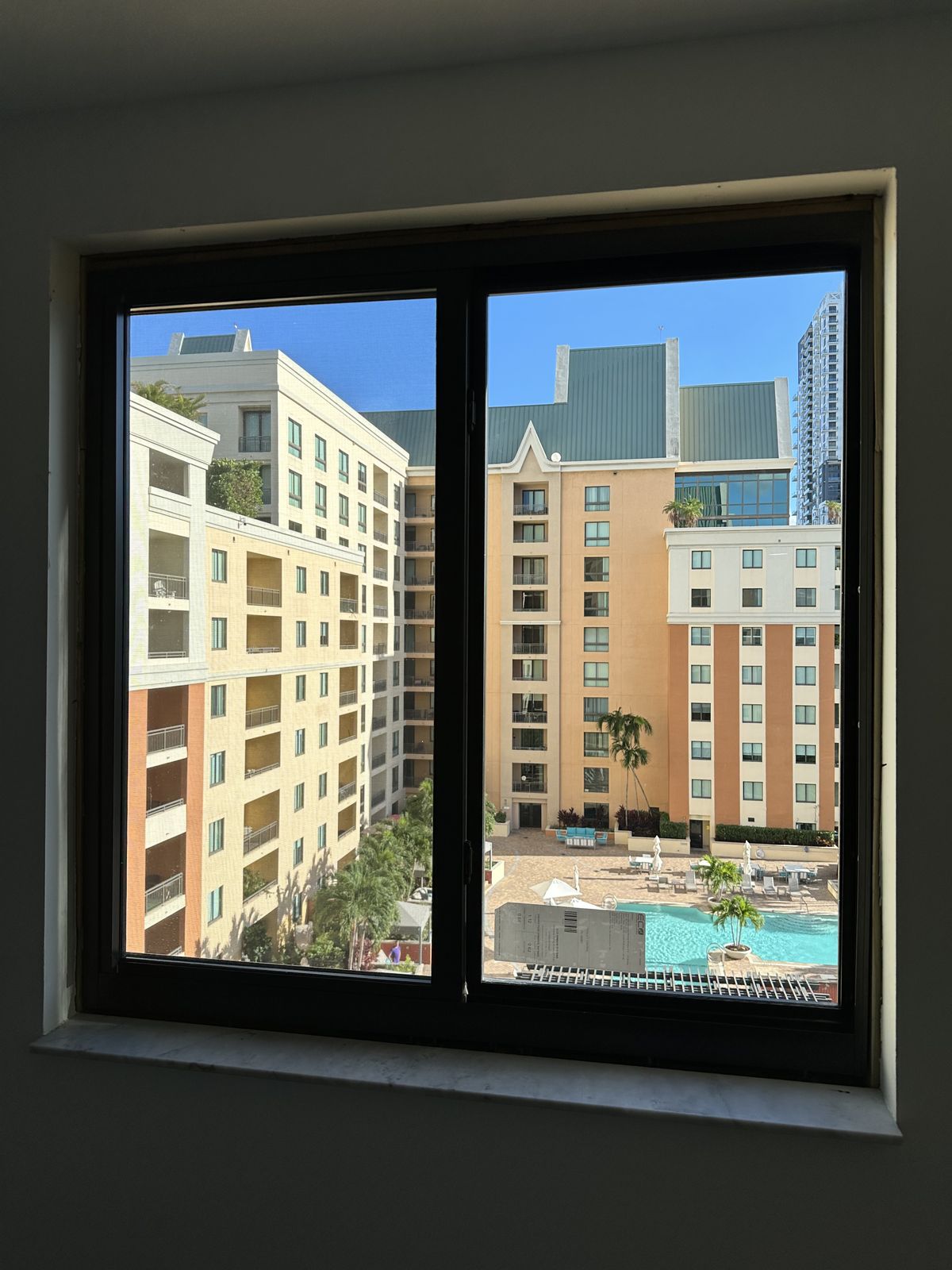
Black horizontal rolling window in a high-rise condo
Real photos from South Florida window and door jobs. They show completed or in-progress work — not a specific listing or product for sale.
1. Florida Law: FS 718.113 — Board Authority on Hurricane Protection
What FS 718.113(5) Actually Says
Florida Statute 718.113(5) gives condo associations the right to install hurricane shutters, hurricane-resistant laminated glass, and other code-compliant hurricane protection products on the building's common elements and limited common elements. Critically, this does not require a unit owner vote — the board can act unilaterally, provided:
- • The installation complies with the Florida Building Code
- • The board adopts uniform specifications for the entire building
- • The installation is consistent with the condo declaration
- • Costs are allocated and assessed according to the declaration's sharing formula
Board Vote Required
Board majority (not unit owners) must approve the project, specifications, and contractor
Uniform Specs Required
One product specification applies to the whole building — no mix-and-match by unit owner preference
Assessment to Owners
Costs distributed per declaration formula — usually by unit percentage ownership (UPO)
⚠️ Important: Check Your Declaration First
FS 718.113 provides general authority, but your specific condo declaration governs the details. Some declarations classify windows as limited common elements (associated with your unit — you may be responsible individually) vs. common elements (association's responsibility). The difference determines who pays and who controls the process. Always have a condo attorney review your declaration before assuming anything.
2. Who Pays for Impact Windows in a Florida Condo?
The answer depends on three factors: how your declaration classifies windows, whether the project is association-initiated or unit-owner-initiated, and how the board allocates costs.
| Scenario | Who Initiates | Who Pays | Unit Owner Can Opt Out? |
|---|---|---|---|
| Building-wide association project | Board of Directors | All unit owners via special assessment | ❌ Generally no |
| Windows as limited common elements | Unit Owner | Responsible unit owner pays | ⚠️ Depends on declaration |
| Owner wants to upgrade independently | Unit Owner | Unit owner pays entirely | ✅ Yes, but needs board approval |
| SIRS-funded capital project | Association | Reserve fund + potential assessment | ❌ No |
✅ Association Project: Advantages
- • Volume discount — entire building negotiated as one contract
- • Uniform specifications qualify for maximum insurance discount
- • Single permit and inspection for entire building
- • SIRS reserve planning can fund it over time
- • Board controls timeline and contractor selection
⚠️ Unit Owner Independent: Complications
- • Must match building-specified product exactly
- • Requires separate architectural review committee approval
- • Separate permit — may be delayed by building-wide permit hold
- • Association may refuse if building-wide project is planned
- • No volume pricing — pays retail rate
3. The Surfside Law & SIRS — Impact on Window Planning
The 2021 Champlain Towers South collapse in Surfside led to Florida's most significant condo safety legislation in decades. The 2022 Structural Integrity Reserve Study (SIRS) law — known as SB 4-D — fundamentally changed how associations must fund capital improvements.
SIRS Required for 3+ Story Condos
Residential condo associations with buildings of 3 or more habitable stories must complete a Structural Integrity Reserve Study every 10 years. The SIRS evaluates the building envelope — including windows and doors — and establishes required reserve funding for replacement.
Reserves Can No Longer Be Waived
Pre-Surfside, condo associations could vote to waive or reduce structural reserves. That ended with SB 4-D. As of 2024, associations must fully fund SIRS-required reserves. This means hurricane window replacement — if included in the SIRS — must be budgeted and funded over time.
Milestone Inspections Trigger Urgency
Buildings 30 years or older (25 years if within 3 miles of the coast) must complete milestone structural inspections. If inspectors identify window or building envelope deficiencies, the association may be legally required to remedy them — which often means impact window upgrades.
Window Projects as Capital Expenditures
Under the new SIRS framework, associations that proactively include impact window replacement in their reserve study can fund it over 5–10 years through regular contributions — avoiding the shock of a large special assessment. This is the financially prudent approach for any building with aging windows.
4. DP Ratings by Floor Height — Why Upper Floors Need Stronger Windows
One of the most common mistakes in high-rise condo window specifications is ordering the same DP-rated product for every floor. Wind loads increase significantly with height, and Florida Building Code accounts for this through the velocity pressure exposure coefficient (Kz) — a multiplier that increases at every height interval.
| Floor Level | Approx. Building Height | Missile Level Required | Minimum DP (HVHZ) | Corner Window DP |
|---|---|---|---|---|
| Ground / 1st floor | 0–15 ft | Large Missile (ASTM E1996) | DP+40 | DP+50 |
| 2nd–3rd floor | 15–35 ft | Large Missile (≤30 ft) / Small (>30 ft) | DP+50 | DP+60 |
| 4th–6th floor | 35–65 ft | Small Missile (ASTM E1996) | DP+60 | DP+75 |
| 7th–15th floor | 65–150 ft | Small Missile | DP+75 to DP+100 | DP+100+ |
| 16th floor and above | 150+ ft | Small Missile | DP+100 to DP+130+ | Engineer specified |
Large Missile Testing (Below ~30 ft)
A 9-pound 2×4 board fired at 50 feet per second — simulating heavy debris like construction materials, roof tiles, and tree limbs that can reach ground-floor windows during a hurricane. Required for the first 30 feet of building height per Florida Building Code.
Small Missile Testing (Above ~30 ft)
Ten 2-gram steel balls fired at 130 fps — simulating gravel, shingle granules, and small debris that reaches upper floors. Lighter debris, but higher wind speed at elevation. Many associations specify large missile glass for the entire building for maximum protection and simplified specifications.
Critical: The DP values in the table above are minimums for HVHZ zones (Broward, Miami-Dade). Your structural engineer or the building permit plans will specify exact DP ratings per opening based on window size, floor level, exposure category (Exposure C or D for coastal), and location (corner vs. field). Never order condo windows from a specification that doesn't address floor-by-floor requirements.
5. Insurance: Master Policy vs HO-6 for Condo Windows
Florida condo insurance has two layers that interact in ways that often confuse unit owners. Understanding both is essential when planning an impact window project.
🏢 Condo Master Policy (Association)
- Covers: Building structure, common elements, building envelope
- Windows: In most master policies, windows that are part of the building envelope are covered for storm damage
- Impact upgrades: The master policy may require all openings to be protected for full building coverage
- Wind mitigation: Building-wide impact windows → association gets full wind mitigation discount on master policy → lower assessments for all owners
🏠 Unit Owner HO-6 Policy
- Covers: Interior improvements, personal property, liability
- Windows: If classified as limited common elements — unit owner may need to insure
- Impact credit: Individual HO-6 may give the full opening-protection credit (varies by insurer) only if ALL openings in unit are protected
- Balcony/lanai: Sliding glass doors on lanais are often classified as limited common elements — check your declaration
💡 How the Insurance Discount Works for Condos
When an association completes a building-wide impact window project:
- → Association submits OIR-B1-1802 wind mitigation form for the master policy
- → Master policy becomes eligible for the wind-mitigation discount on its hurricane-wind portion (any savings flow through to unit assessments)
- → Each unit owner submits their own OIR-B1-1802 for their HO-6 policy
- → HO-6 becomes eligible for the opening-protection credit (amount varies by insurer)
- → Insurance credits can offset part of the special assessment cost over time
6. How a Building-Wide Condo Impact Window Project Works
Board Resolution & Engineering Scope
The board votes to pursue impact window replacement. A structural engineer or window consultant assesses the building and drafts specifications: DP ratings by floor, missile level requirements, product list, frame color/style standards. This document governs everything.
Unit Owner Notification (FS 718.112)
Owners must be notified of the project, specifications, and planned cost allocation before contracts are signed. While a unit vote is not required under FS 718.113, transparency is legally required and practically important for maintaining community trust.
Contractor Selection & Bidding
Typically 3+ licensed contractors bid based on the engineering spec. Volume of a multi-unit building creates leverage — per-unit cost is almost always lower than individual unit upgrades. Ensure all bidding contractors carry the required GL insurance and workers comp for high-rise work.
Permit Application (One Master Permit)
The association applies for one building permit covering all units. The permit plan includes floor-by-floor DP ratings, NOA/FPA product numbers, and installation details. A single permit inspection at the end covers the entire project.
Special Assessment or Reserve Draw
Costs are allocated per the declaration's unit percentage ownership formula. If reserves are insufficient (and cannot be waived post-SIRS), a special assessment is levied. Owners have a right to payment plans for large assessments in some cases.
Installation Floor by Floor
Professional crews work floor by floor or wing by wing, minimizing disruption. Temporary weatherproofing is used during installation. The management company coordinates unit access with residents.
Final Inspection & Wind Mitigation Filing
After permit close, the wind mitigation inspector submits OIR-B1-1802 for the master policy. Individual owners should also file their own forms for their HO-6 policies. Premium reductions begin at next renewal.
7. Unit Owner Rights When the Association Acts
Even though the board can act without a unit vote, Florida law and association documents give owners important rights in the process:
Right to Review Specifications
Before the contract is signed, owners have the right to review the engineering specifications, NOA product approvals, and cost allocation methodology under FS 718.111.
Right to Challenge Cost Allocation
If you believe the cost allocation formula in the declaration is being misapplied, you can challenge it through the Division of Condominiums, Timeshares and Mobile Homes (DBPR) arbitration process.
Right to Request Payment Plans
For special assessments over a certain threshold, many declarations require or allow payment plans. Check your documents — Florida law and many declarations allow installments for large assessments.
Right to Inspect Contractor License
You have the right to verify the contractor's DBPR license and insurance coverage. The association must hire a properly licensed contractor — CGC or CBC license required for structural/window work.
Right to Board Meeting Minutes
All board votes, contractor selections, and financial decisions regarding the project must be reflected in board meeting minutes, which owners have the right to inspect.
Right to Independent Installation (if allowed)
If the declaration permits individual window replacement, an owner can upgrade independently but must match building specifications exactly and obtain board architectural committee approval first.
Frequently Asked Questions
Who pays for impact windows in a Florida condo — the HOA or unit owner?▼
It depends on the condo declaration. Under FS 718.113, if the association installs hurricane protection as part of a building-wide project, costs are typically assessed to unit owners. If the window is classified as a limited common element, the association may be responsible. If the unit owner installs independently (where the declaration permits), they pay. Always review your specific declaration before assuming.
Can a Florida condo HOA require impact windows without a unit owner vote?▼
Yes. Under Florida Statute 718.113(5), condominium boards can install hurricane-resistant products on common elements and limited common elements without a unit owner vote, as long as the work complies with Florida Building Code. The board must adopt uniform specifications and can assess the costs to unit owners.
Do upper-floor condo windows need higher DP ratings than ground floor?▼
Yes. Wind loads increase significantly with height. The building height coefficient (Kz) means upper floors face stronger wind pressure. Ground-floor windows in HVHZ typically require DP+40 minimum; upper floors may need DP+60 or higher. Corner windows face higher loads than center windows at the same floor. Always specify DP ratings by floor and location — not just 'impact rated.'
What is the difference between large missile and small missile impact testing for condos?▼
Florida Building Code requires Large Missile impact testing (a 9-lb 2x4 at 50 fps) for windows within the first 30 feet of building height — simulating heavy ground debris. Above 30 feet, Small Missile testing (steel ball bearings) is permitted, since large debris is less likely to reach upper floors. Many manufacturers use large missile glass for the entire building for maximum protection.
Does my condo master insurance cover impact window installation?▼
The condo master (association) policy covers the building structure and common elements — including windows that are part of the building envelope in most policies. Your HO-6 unit owner policy covers interior elements and personal property. When the association installs impact windows building-wide, the cost is typically assessed, not paid from reserves unless the SIRS study specifically funds it.
What is the Surfside law and how does it affect condo impact windows in Florida?▼
The 2022 Surfside law (SB 4-D) requires Florida condo associations with buildings 3+ stories to complete a Structural Integrity Reserve Study (SIRS) and fully fund structural reserves. While not directly mandating impact windows, the SIRS process often identifies hurricane protection upgrades — and associations can no longer waive structural reserves, meaning window replacement projects must be properly funded and planned.
Condo & High-Rise Impact Window Estimates
Vieser Construction works with condo associations and individual unit owners across Broward, Miami-Dade, and Palm Beach counties. We provide floor-by-floor DP specifications, manage the permit, and coordinate multi-unit installations.
Full Project Coordination · Fort Lauderdale, FL